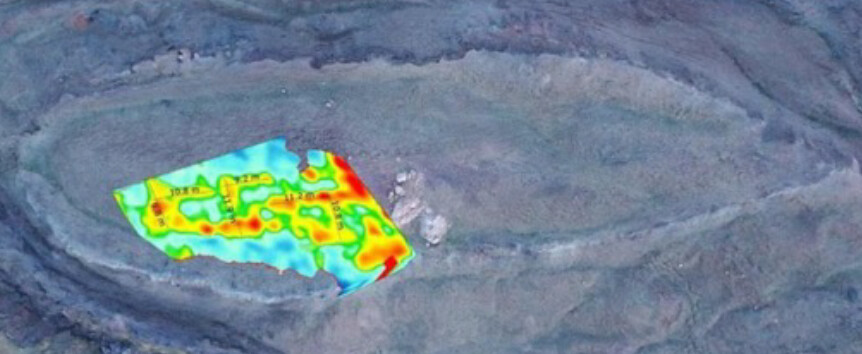
A team of American researchers studying Noah’s Ark in Turkey claim to have found new evidence suggesting the Ark may be buried in a mountainous region of the country. The group, known as the “Noah’s Ark Scans” team, has identified tunnels and underground chambers within the Durupınar Formation that intriguingly appear to match the design described in the Book of Genesis.
While most geologists still categorise the site as a natural formation, the use of Ground Penetrating Radar (GPR) has revealed what appears to be an organised network of corridors. This suggests that the structure might not be a solid block of rock, but possibly a hollow object with internal sections.
Details of the Discovery
Researcher Andrew Jones led the project, mapped what he describes as an “atrium” — a central chamber where several tunnels converge.
Geometry: Angular structures have been detected at depths of up to 6 metres.
Technology: In addition to GPR, infrared thermography has detected a heat pattern resembling the shape of a ship’s hull.
Consistency: The internal layout appears to match the three levels mentioned in the Bible.
Furthermore, soil samples collected in 2024 revealed unusually high levels of potassium. This is noteworthy because elevated potassium levels can sometimes indicate the decay of large quantities of organic material, such as wood.
The Durupınar Formation, located about 18 miles from Mount Ararat and gained attention in 1948 after earthquakes and heavy rainfall revealed its distinctive shape. Since then, its measurements have continued to spark interest, as the structure is approximately 515 feet (157 metres) long — very close to the 300 cubits mentioned in the Bible.
Looking ahead, the team plans to conduct core drilling in the next research season. They hope to insert cameras into the structure to determine whether these spaces correspond to the rooms described in Genesis 6:14.
Biblical archaeology continues to play an essential role today, as it provides material evidence that connects ancient accounts to historical reality. For many, such discoveries not only validate the Scriptures but also make the message of faith more tangible and relatable.
If you are interested in exploring Bible stories further, audiovisual content can be an excellent starting point. Recent dramas such as Genesis, Kings, and Paul, the Apostle, available on Univer Video, bring these stories to life. The platform also features documentaries that delve into archaeological findings, offering more insight into the historical context of the Bible.
Additionally, you can check the weekly schedule of the Universal Church. Every day, there is a meeting dedicated to studying the Bible, listening to the Word of God, and learning how to apply the valuable lessons we gain from it. The Bible is not merely a book of history; as it says in Hebrews 4:12, “the Word of God is living and active, and able to discern the thoughts and intentions of the heart.”
Source: https://noahsarkscans.com/